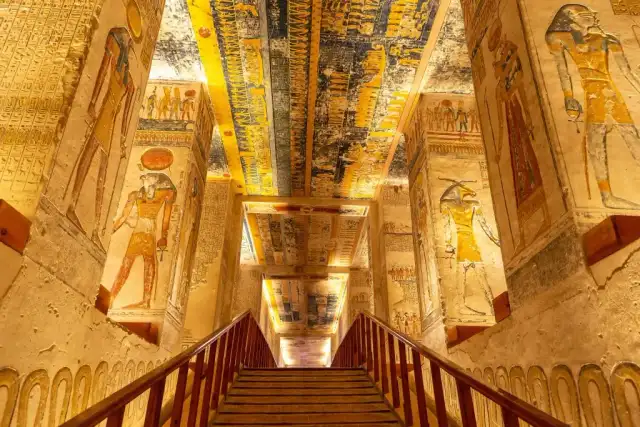
Find why the Valley of the Kings features on most Egypt Tours, from royal tombs and ancient paintings to the story of Tutankhamun and New Kingdom history.
There are places that appear on travel itineraries because they are expected, and there are places that appear because they genuinely deserve to be there. The Valley of the Kings belongs firmly in the second category. Cut into the limestone cliffs on the west bank of the Nile opposite Luxor, this narrow desert valley holds the tombs of sixty three pharaohs and nobles from Egypt's New Kingdom period, spanning roughly five hundred years of royal burial tradition. Egypt Tours return to this site repeatedly not out of habit but because nothing else in the country quite prepares visitors for what they find inside the carved chambers beneath the rock on Egypt Tours.
Popular Egypt Tour Packages
Why the Valley of the Kings visited on most Egypt Tours
1. The Scale of Royal Ambition
The pharaohs of the New Kingdom chose the west bank of the Nile deliberately. In ancient Egyptian belief the west, where the sun set each evening, was the realm of the dead, and the cliffs above the valley were thought to resemble the hieroglyph for horizon, the place where the sun crossed between worlds. The tombs cut into these cliffs were not simply burial chambers but elaborate architectural statements about power, divinity, and the journey through the afterlife. Some extend over a hundred metres into the rock with multiple chambers, descending staircases, and side rooms covered entirely in paintings and hieroglyphic texts. Egypt Tours that spend proper time here give travellers a genuine sense of the scale of royal ambition that drove this extraordinary construction programme across centuries on Egypt Tours.
2. The Paintings and Hieroglyphic Texts
What separates the Valley of the Kings from other ancient sites is what covers the walls inside. The tomb paintings here are not decorative in the way most visitors expect. They are functional religious texts drawn from works like the Amduat, the Book of Gates, and the Book of the Dead, designed to guide the deceased pharaoh safely through the dangers of the underworld and into eternal life. The colours in many tombs have survived with a vividness that makes them look freshly painted, preserved by the dry desert air and sealed chambers for over three thousand years. Egypt Tours that include a knowledgeable guide at the Valley of the Kings transform the experience entirely because the images on these walls tell specific stories that are invisible without context, and understanding them changes the way the rest of Egypt Tours unfolds.
3. Tutankhamun's Tomb
Tutankhamun ruled for only about nine years and died at around nineteen years of age, making him a relatively minor pharaoh by the standards of his era. His tomb, discovered by Howard Carter in November 1922, changed that assessment permanently. The burial chamber was found almost entirely intact, filled with over five thousand objects including gilded furniture, chariots, weapons, clothing, and the famous solid gold death mask that has since become the most recognisable image from ancient Egypt. The discovery generated global attention on a scale that had never been seen around an archaeological find before. Egypt Tours that include the tomb give travellers a direct connection to that story, and the young king's mummified remains still rest in the burial chamber today, making the experience on Egypt Tours more immediate than almost any other site in the valley.
4. The Tomb of Seti I
If Tutankhamun's tomb is the most famous in the valley, the tomb of Seti I is widely considered the most impressive. Seti I was the father of Ramesses II and ruled during one of the most prosperous periods of the New Kingdom, and the tomb built for him reflects that wealth and ambition in extraordinary detail. The burial chamber extends over a hundred metres into the cliff with walls and ceilings covered in some of the finest painted reliefs in Egypt, depicting astronomical scenes, religious texts, and images of the pharaoh before the gods with a precision and artistry that experienced Egyptologists still study carefully. Access is limited to protect the paintings, which makes visiting it a privilege that not every Egypt Tours itinerary includes but one that every Egypt Tours focused on the New Kingdom should make the effort to arrange.
5. The Tomb of Ramesses VI
The tomb of Ramesses VI is among the most visited in the valley after Tutankhamun's, and it earns that attention on its own considerable merits. The ceiling of the burial chamber is painted with the complete Book of the Day and the Book of the Night, astronomical texts that chart the journey of the sun through the sky and the underworld in a continuous visual narrative across the entire vaulted surface. Looking up at this ceiling is one of those genuinely arresting moments that Egypt Tours regularly produce when visitors least expect them. The tomb is large enough to move through comfortably and well enough lit to appreciate the detail in the paintings throughout. It gives Egypt Tours a different quality of experience from the smaller, more intimate tombs elsewhere in the valley and consistently satisfies travellers who include it on Egypt Tours.
Best Time to Visit the Valley of the Kings on Egypt Tours
October to April is the most practical period for visiting the Valley of the Kings because temperatures in the desert cliffs above Luxor are significantly more manageable than the summer months. Between May and September the heat at the site reaches levels that make extended outdoor time genuinely uncomfortable, and the tombs themselves, while cooler inside, involve walking exposed paths between entrances in full sun. Winter days in Luxor are clear and bright, which suits the early morning visits that Egypt Tours typically schedule before the midday heat builds. Arriving at the valley shortly after opening time gives Egypt Tours the best combination of comfortable temperatures, manageable crowds, and the particular quality of morning light that the desert cliffs reflect across the site on Egypt Tours.
How to get to Valley of Kings on Egypt Tours
The Valley of the Kings sits on the west bank of the Nile opposite Luxor city, reached by crossing the river either by local ferry or by bridge further south. Most Egypt Tours arrange private transport from the east bank that handles the crossing and the drive to the valley entrance comfortably. The site is about eight kilometres from central Luxor once across the river, passing through agricultural land and then into the desert as the cliffs come into view. A small electric train runs between the valley entrance and the tomb area inside, which reduces walking in the heat considerably. Combining the Valley of the Kings with the nearby Temple of Hatshepsut and the Colossi of Memnon in a single west bank morning gives Egypt Tours the most efficient and satisfying use of time on Egypt Tours.
Things to do at the Valley of the Kings on Egypt Tours
Most Egypt Tours include entry to three tombs in the standard ticket, with additional tickets available for Tutankhamun's tomb and the tomb of Seti I separately. Choosing which tombs to visit benefits from guidance because the sixty three available vary considerably in size, condition, and artistic quality. The on-site visitor centre provides useful historical context before entering the valley. Combining the valley with the Temple of Hatshepsut at Deir el-Bahari, a short drive away, gives Egypt Tours a complete west bank morning that covers both the burial and memorial temple traditions of the New Kingdom. A hot air balloon flight over the west bank at sunrise, available from Luxor, provides an aerial perspective of the valley and surrounding monuments that gives Egypt Tours one of its most memorable visual experiences.
What to Carry for the Valley of the Kings on Egypt Tours
Comfortable walking shoes handle the paths between tomb entrances and the uneven stone steps inside the chambers without difficulty. Lightweight clothing suits the outdoor sections of the visit while a layer is useful for early morning arrivals between November and February when the desert air is cool before the sun rises fully over the cliffs. Sunscreen and a hat matter considerably at this site because the paths between tombs offer limited shade. Carrying water is important because facilities inside the valley are limited and the heat builds quickly through the morning. A small torch can be useful in the darker sections of larger tombs where the installed lighting does not reach every painted surface that deserves attention on Egypt Tours, and Egypt Tours that prepare these basics in advance move through the site more comfortably.
Health and Safety at the Valley of the Kings on Egypt Tours
The Valley of the Kings is a well managed site with clear paths and good visitor infrastructure, making it straightforward and safe for most travellers on Egypt Tours. Heat is the primary consideration, particularly between April and October when temperatures in the desert cliffs above Luxor reach levels that require genuine caution. Staying hydrated throughout the visit and limiting outdoor exposure during the hottest midday hours are the most important practical measures. Inside the tombs, some chambers are narrow and poorly ventilated, which matters for visitors with claustrophobia or breathing sensitivities. Photography restrictions apply inside most tombs and should be respected to protect the paintings. Using a licensed guide throughout the valley ensures Egypt Tours get the historical context the site deserves and keeps the visit well organised on Egypt Tours.
Where to Stay for the Valley of the Kings on Egypt Tours
Luxor is the natural base for visiting the Valley of the Kings and offers accommodation on both sides of the Nile. Staying on the west bank places Egypt Tours directly beside the valley and the surrounding monuments, with several comfortable guesthouses and smaller hotels operating in the villages near the site. East bank hotels along the Nile Corniche offer views across the river toward the cliffs that contain the tombs, and the crossing by ferry takes only a few minutes from the main landing. Larger hotels in central Luxor provide easy access to both the east bank temples and the west bank sites within the same base. Allocating at least two nights in Luxor gives Egypt Tours enough time to cover the Valley of the Kings, Karnak, Luxor Temple, and the west bank monuments without feeling rushed on Egypt Tours.
Why Book with Lamz Tours and Travel for Egypt Tours
The Valley of the Kings is a site that gives back in proportion to the preparation brought to it, and we design Egypt Tours that approach it with the knowledge and structure it deserves. We include knowledgeable licensed guides who bring the tomb paintings and royal histories to life in ways that make the visit genuinely educational rather than simply visual. Our itineraries allocate proper time at the valley rather than rushing through it as a single checkbox on a packed day. Combined with Karnak, Abu Simbel, and the other pharaonic sites that make Upper Egypt extraordinary, we build Egypt Tours that follow the full arc of ancient Egyptian history from the pyramids of Giza to the cliffs of the west bank on Egypt Tours.
Ready to plan your safari?
Talk to a Lamz Tours specialist and get a tailor-made quote.
Make an enquiry