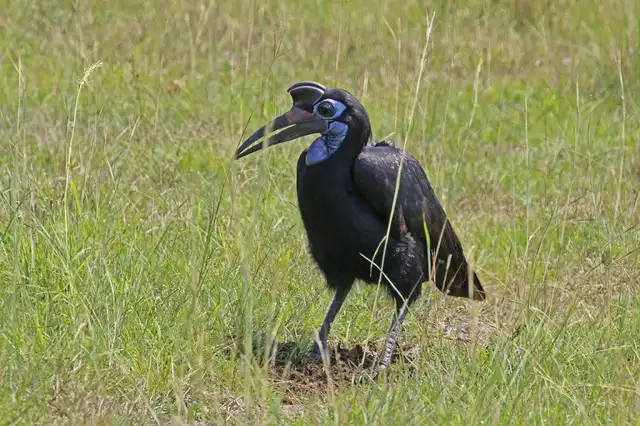
Are you a tourist or simply a curious birder wishing to widen your knowledge about the Abyssinian ground hornbill and where to find it in Uganda? Lamz Tours and Travel presents to you the charismatic Abyssinian ground hornbill, a bird species that adds an amusing touch to Uganda's lively avian scene. The Abyssinian ground hornbill is typically covered in jet-black plumage adorned with a pop of vibrant red on its throat and sporting a whimsical helmet-like casque on its massive bill. The casque, particularly pronounced in males, serves as both a functional tool and a charming accessory, making them stand out in the avian world.
Uganda's game parks offer the best natural habitats for the Abyssinian ground hornbills to thrive. With the exceptional direction by guides from Lamz Tours and Travel, enthusiastic birders have a better chance to spot them at Murchison Falls National Park, Queen Elizabeth National Park, and Kidepo Valley National Park among many other areas. Prepare to be entertained and captivated by the bird's whimsical charm as it flits and forages, leaving a trail of lighthearted wonder in its wake.
The Abyssinian ground hornbill thrives in tropical and subtropical climates, favoring regions with warm temperatures and moderate rainfall. They are well-adapted to the diverse ecosystems of Uganda that includes savannah woodlands and grasslands.The Abyssinian hornbill prefers habitats with large trees for nesting and roosting. Acacia and baobab trees are among their favored choices. The availability of suitable trees is crucial for their breeding and survival.
Other known facts about the Abyssinian ground hornbill of Uganda include;
The Evolutionary History and confusion with other bird species
The Abyssinian ground hornbill has a long evolutionary history and belongs to the Bucorvidae family. The species is often confused with the southern ground hornbill (Bucorvus leadbeateri) due to the similarities in appearance. However, they are distinct species with differences in range and subtle physical characteristics. For example the Abyssinian ground hornbill species primarily found in eastern Africa and the southern species in southern Africa. While both exhibit black plumage and possess casques on their bills, the southern ground hornbill has a more prominent casque with a distinct helmet-like appearance, and its coloration includes white primary feathers. Abyssinian ground hornbills prefer varied habitats in eastern Africa, whereas southern ground hornbills are associated with savannas and open woodlands. Additionally, their social structures differ slightly, with both species being monogamous but the southern ground hornbill forming complex family groups. These distinctions contribute to the unique ecological roles played by each species within their respective regions.
Why "Abyssinian" ground hornbill
The name "Abyssinian" is derived from the historical term for the Ethiopian Highlands, also known as Abyssinia. While their range extends beyond Ethiopia, the name reflects the bird's association with this region. The term "ground" emphasizes their terrestrial habits, as they are often seen foraging on the ground rather than in trees.
Primary Predators and threats of the Abyssinian ground hornbills
The primary predators of Abyssinian ground hornbills are large carnivores, such as leopards and birds of prey. While arboreal or climbing snakes may threaten eggs and chicks. Additionally, large mammals such as hyenas may pose risks during ground foraging or when the hornbills are roosting. Despite these threats, Abyssinian ground hornbills have evolved adaptive behaviors and nesting strategies to minimize predation risk, showcasing their resilience in their African ecosystems. Human activities, habitat loss, and poaching also pose significant threats to their populations.
Display of Aggression among the Abyssinian ground hornbills
While Abyssinian ground hornbills are not inherently aggressive, they can display territorial behavior, especially during the breeding season. They may defend their nesting sites vigorously against intruders, showcasing a protective nature.
Activity Patterns and Lifespan of the Abyssinian ground hornbills
The Abyssinian ground hornbill is diurnal, meaning they are active during the day. They spend their time foraging for food, including small mammals, reptiles, and insects. In captivity, they can live up to several decades, but the lifespan in the wild is influenced by various factors, including predation and environmental conditions.
Mating Behavior and Courtship among the Abyssinian ground hornbills
The Abyssinian ground hornbills engage in elaborate courtship rituals to establish and strengthen pair bonds. These rituals involve mutual displays, vocalizations, and symbolic movements. The courtship phase plays a crucial role in ensuring the compatibility of potential mates.
Favorite meal and foraging habits among the Abyssinian ground hornbills
Their diet primarily consists of a varied selection of small mammals, reptiles, insects, and fruits. Abyssinian ground hornbills are opportunistic foragers, using their powerful bills to probe the ground for food. They have a particular fondness for larger insects, small mammals, and even reptiles that they can capture on the ground.
Breeding Season and Incubation Period among the Abyssinian ground hornbills
The breeding season for the Abyssinian ground hornbill typically aligns with the rainy season when food resources are abundant. After successful courtship, the female lays eggs in a nest cavity, often located in the hollow of a large tree. The incubation period lasts around 40 days, during which the female diligently tends to the eggs.
Sexual Dimorphism among the Abyssinian ground hornbills
Abyssinian ground hornbills exhibit sexual dimorphism, where males and females can be distinguished by subtle differences in size and bill shape. In terms of size, the males are generally slightly larger than females. This size difference is often subtle but can be noticeable, particularly in the overall body dimensions.
Regarding the bill shape, the casque of male Abyssinian ground hornbills may exhibit slight variations compared to that of females. While both genders have this feature, there can be differences in size or shape, with males often having more prominent casques.Regarding coloration, males may have slightly different coloration or markings compared to females. This could include variations in the intensity or pattern of certain plumage features, although the differences are generally subtle.
Monogamous behavior among Abyssinian ground hornbills
Abyssinian ground hornbills are typically monogamous, forming long-term partnerships that extend beyond the breeding season. Mated pairs often engage in mutual preening and vocalizations as part of their bonding.
Parental care and Nest building among Abyssinian ground hornbills
Both male and female Abyssinian ground hornbills actively participate in raising their young. After hatching, the parents work collaboratively to care for the chicks, bringing them food and protecting them from potential threats. The nest is meticulously constructed within a tree cavity, and both parents contribute to the nest-building process.
The best time to spot the Abyssinian ground hornbills in Uganda
The optimal time to visit Uganda National Parks for spotting the Abyssinian ground hornbill is during the dry seasons, which typically occur from December to February and June to August. During these periods, the weather is more predictable, and the reduced vegetation enhances visibility, making it easier to observe the hornbill in its natural habitat. Additionally, many bird species, including the Abyssinian ground hornbill, are more active during these months, offering better opportunities for birdwatchers and nature enthusiasts to witness their behaviors and capture memorable moments.
For more information about an Abyssinian ground hornbill birding adventure in Uganda, contact Lamz Tours and Travel via email at info@Lamz Tours and Travel.com and Lamz Tours and Travel@gmail.com. For personalized assistance, reach out via phone call or WhatsApp to +000 000 000 000 and +000 000 000 000. With the right preparations and a spirit of adventure, this journey will undoubtedly be a highlight of any trip to Uganda.
Ready to plan your safari?
Talk to a Lamz Tours specialist and get a tailor-made quote.
Make an enquiry