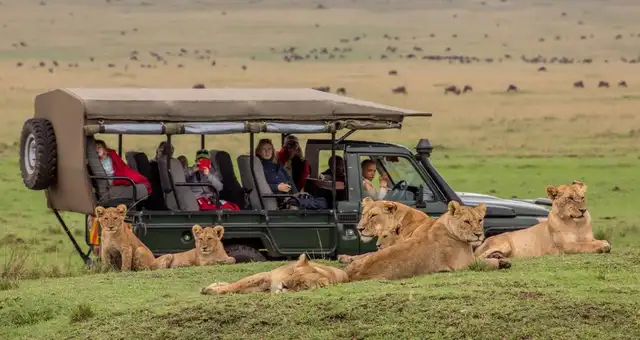
The term "Big Five" was coined by hunters in the early 20th century to refer to the five most iconic and elusive game animals in Africa: the lion, leopard, rhinoceros, elephant, and Cape buffalo. Today the phrase means something very different, these are the five species every Kenya safari traveller hopes to photograph rather than hunt, and Kenya remains one of the most reliable places on the continent to see all five in a single trip.
In short: the Masai Mara is Kenya's single best park for seeing all five together, while Ol Pejeta and Lake Nakuru fill in guaranteed rhino sightings if your itinerary needs the extra insurance.
Popular Big Five Safari Packages
What Are the Big Five, and Where to See Them on a Kenya Safari
1. Lion
The African lion is one of the most iconic animals to see on a Kenya safari, particularly in the Masai Mara, where large prides lounge in open grassland and are often spotted within minutes of a game drive starting. Dawn and dusk drives give the best chance of catching lions active and hunting rather than resting in shade.
2. Leopard
The leopard is a solitary and elusive predator, a thrilling sight to behold on a Kenya safari in the Masai Mara. Leopards spend much of the day draped over tree branches or hidden in thickets, so they are generally the hardest of the five to spot, an experienced local guide makes a real difference here.
3. Elephant
The African elephant is another must-see animal during a Kenya safari in the Masai Mara, though Amboseli National Park is famous for its large elephant herds, often seen against the backdrop of Mount Kilimanjaro, arguably Kenya's single most photographed wildlife scene.
4. Buffalo
The African buffalo is a key species to observe on a Kenya safari, with the Masai Mara home to an estimated 20,000 buffalo, making them one of the most frequently seen animals in the reserve. Buffalo tend to stay in large groups, creating a genuinely spectacular sight when a full herd crosses open plains.
5. Rhino
Rhino is the species most likely to need a dedicated stop. Lake Nakuru National Park is one of the few places in Kenya where you can see both black and white rhinos, while Ol Pejeta Conservancy is home to the last two northern white rhinos on Earth, Najin and Fatu, making it a globally significant conservation site as well as a near-guaranteed sighting.
6. Where to See All Five Together
Seeing lion, leopard, elephant, buffalo, and rhino in one park is rare, but the Masai Mara makes it possible. For travellers who want extra certainty on rhino specifically, pairing the Mara with Ol Pejeta or Lake Nakuru makes the Big Five highly achievable across a single well-planned itinerary.
Weather and Climate
Kenya's safari parks are warm and relatively dry from June to October and January to February, with daytime temperatures often between 20°C and 27°C. Early morning game drives can be cool, so pack a light jacket even in the dry season.
Best Time to See the Big Five
How to Get There
Kenya's gateway is Jomo Kenyatta International Airport (NBO) in Nairobi. The Masai Mara is a 5 to 6-hour drive or a short domestic flight away, Amboseli around 4 hours, Lake Nakuru roughly 2 hours, and Ol Pejeta on the Laikipia Plateau about 3 hours north of Nairobi.
Health and Safety Tips
A yellow fever vaccination is commonly required or recommended depending on your routing into Kenya, and malaria risk exists across most safari areas, so discuss prophylaxis with your doctor before travel. Always stay inside the vehicle during game drives unless your guide says otherwise, and keep a respectful distance from all Big Five species, they are wild animals first.
Why Book Your Big Five Safari with Lamz Tours and Travel
Lamz Tours and Travel runs dedicated Big Five itineraries such as the 7-day Kenya Big Five Safari Adventure, built specifically around finding all five species. Contact us at info@Lamz Tours and Travel.com or +000 000 000 000 to start planning your Big Five safari in Kenya.
Ready to plan your safari?
Talk to a Lamz Tours specialist and get a tailor-made quote.
Make an enquiry