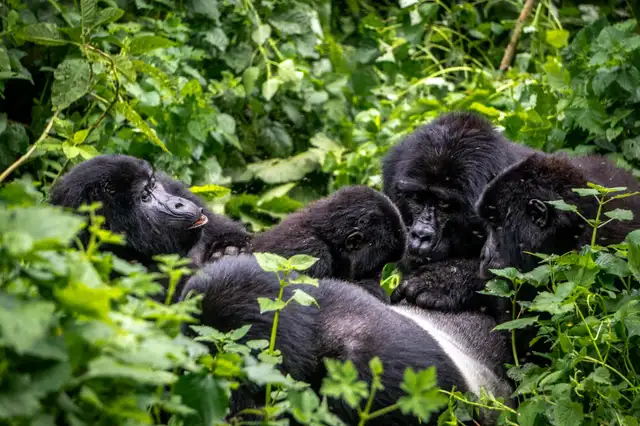
Kenya does not have wild mountain gorillas, so this is not really a like-for-like comparison, it is a choice between two entirely different kinds of wildlife experience. Gorilla trekking in Uganda means hiking on foot through rainforest to spend one hour with a single habituated gorilla family. A Kenya Big Five safari in the Masai Mara means open-vehicle game drives across the savanna, tracking lions, elephants, buffalo, leopards, and rhinos, often alongside the Great Migration. Both are extraordinary, but they suit different travellers, budgets, and expectations.
If you cannot decide, you do not have to, several itineraries combine both, such as a Masai Mara safari paired with a Tanzania Serengeti extension, or a custom trip adding a few days of Uganda gorilla trekking on either end. Here is how the two compare.
Popular Packages
Uganda Gorilla Trekking or Kenya Big Five Safari: Which Should You Choose?
1. Two Fundamentally Different Experiences
Gorilla trekking is an on-foot forest hike through Bwindi Impenetrable National Park, ending in a strictly timed hour with one gorilla family. A Masai Mara safari is a vehicle-based wildlife circuit across open savanna, with multiple game drives a day and the chance to see dozens of species, not just five. One is an intimate, physical, single-species encounter; the other is a broad, comfortable, high-volume wildlife experience.
2. Cost
A Uganda gorilla permit alone costs 800 US dollars per person before transport or lodging, which usually pushes a short gorilla trip to 1,200 to 2,000 US dollars all-in. A Masai Mara safari has no permit fee of that scale, park entry runs closer to 70 to 100 US dollars per person per day, so a comparable 3 to 5-day Kenya trip often costs less overall, though multi-day luxury camps can close that gap quickly.
3. How Predictable Are the Sightings?
Gorilla trekking has a success rate above 95 percent, because trackers locate the family before guests set off, making the outcome highly predictable for the price. A Masai Mara safari cannot guarantee any single species on any single drive, though the reserve's high game density makes lion and elephant sightings very likely and, with enough days, all five species are realistically achievable, especially with an experienced guide who knows the Mara's ecosystem.
4. Physical Demand and Terrain
Gorilla trekking is genuinely strenuous, involving 1 to 8 hours of steep, muddy, forest hiking at altitude. A Masai Mara safari is largely seated and vehicle-based, with only short walks at lodges or during optional bush walks, making it far more accessible to travellers with limited fitness, young children, or mobility concerns.
5. Trip Length and Pace
A focused gorilla trek can be done in 3 to 4 days, with one trekking day as the clear highlight. A worthwhile Masai Mara experience typically wants 4 to 7 days to allow multiple game drives, some downtime, and often a second park such as Lake Nakuru or Amboseli, since the reward comes from repeated exposure rather than a single scheduled encounter.
6. Can You Do Both on One Trip?
Yes, and many travellers do. A common route pairs a few days of Uganda gorilla trekking with a Kenya or Tanzania Big Five circuit, such as the 7 Days Masai Mara Kenya Tour and Ngorongoro Serengeti Tanzania Safari as a template, adjusted to include a Uganda extension. This lets you get the intimate primate encounter and the classic wide-open safari in a single well-planned East Africa trip.
Weather and Climate
Bwindi stays cool and often misty year-round, with temperatures between 11°C and 23°C, since it sits at high altitude. The Masai Mara is warmer and drier overall, with daytime temperatures often between 20°C and 28°C, and its own dry season from June to October that overlaps closely with Uganda's dry trekking season.
Best Time to Go
For gorilla trekking, June to September and December to February are driest and most popular. For the Masai Mara, July to October is peak season for the Great Migration and river crossings, though the Big Five are present year-round. The overlap between June and September makes it possible to plan a combined trip without fighting opposite seasons.
How to Get There
Uganda's gateway is Entebbe International Airport (EBB), with Bwindi a 7 to 9-hour road transfer or short flight away. Kenya's gateway is Jomo Kenyatta International Airport (NBO) in Nairobi, with the Masai Mara reached by a 5 to 6-hour road transfer through the Great Rift Valley or a short domestic flight of around 45 minutes.
Health and Safety Tips
A yellow fever vaccination is mandatory for Uganda if arriving from an endemic country, and recommended for Kenya depending on your routing. Malaria risk exists in both destinations, so discuss prophylaxis with your doctor before travel, and carry comprehensive travel insurance covering trip cancellation and medical evacuation for either trip.
Why Book With Lamz Tours and Travel
Lamz Tours and Travel is a fully licensed, Uganda-based tour operator running both gorilla trekking safaris in Uganda and Big Five safaris in Kenya, so we can build an honest itinerary around whichever experience fits your budget, fitness, and time, or combine both into one seamless East Africa trip. Contact us at info@Lamz Tours and Travel.com or +000 000 000 000 to start planning.
Ready to plan your safari?
Talk to a Lamz Tours specialist and get a tailor-made quote.
Make an enquiry