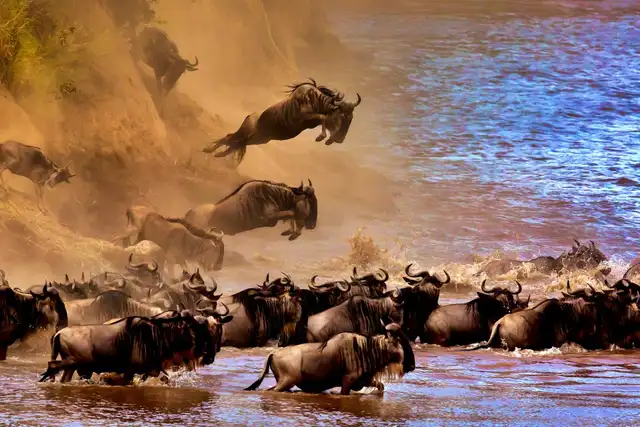
The Great Migration is not a single event in a single place, it is a year-round circular journey. Over two million wildebeest, zebras, and other grazers move across the plains of Tanzania and Kenya each year, following the rains and fresh grazing between the Serengeti and the Masai Mara. Knowing where the herds are in each month is the key to planning a Great Migration safari that actually puts you in front of the action.
In short: January to March is calving in the southern Serengeti, April to June is the northward trek, July to October is the Mara River and Masai Mara peak, and October to November is the return south.
Popular Great Migration Safari Packages
The Great Migration Safari Calendar: Where the Herds Are Each Month in Kenya and Tanzania
1. January to March: Calving Season in the Southern Serengeti
The migration begins in the southern Serengeti, particularly the Ndutu Conservation Area, which is ideal for calving from January to March, when large herds gather and thousands of calves are born. Predators follow the newborns closely, making this one of the most action-packed and photogenic periods of the whole cycle.
2. April to June: The Herds Move North
As calving winds down, the herds begin their northward trek between April and June. In the Serengeti, the migration is most active from April to June, with long columns of animals strung across the plains as they head toward fresh grass and water.
3. June to July: The Grumeti River Crossings
The herds reach the Grumeti River by June, where crossings in the western Serengeti test the animals against crocodiles and strong currents. It is a dramatic warm-up act before the bigger crossings that come next, and a strong choice if you want migration action in Tanzania before the herds cross into Kenya.
4. July to October: The Mara River and the Masai Mara
This is the headline phase. July is the peak month, with herds crossing the Mara River into the Masai Mara, and the crossings continue through October. For the best odds of witnessing crossings, plan between mid-July and late August, when the herds are most concentrated around the river.
5. October to November: The Return South
As the rains approach, the wildebeest begin their journey back south to the Serengeti before the rains in October and November, completing the circle. The cycle then restarts with calving in the south, so there is no true "off" month for the migration itself.
6. December: The Serengeti Hosts the Herds for Longer
Because the herds spend so long in Tanzania, the Serengeti hosts the migration for longer periods, from December to July, giving travelers more flexibility than the Masai Mara's shorter July-to-October window. If your travel dates are fixed outside the Kenyan peak, the Serengeti is usually the safer bet.
Weather and Climate
Both the Serengeti and the Masai Mara are warm and dry from June to October, with cool mornings and nights, so pack layers for early game drives. The wetter months bring greener landscapes and the calving season action in the south.
Quick Reference: Where the Herds Are
January to March: southern Serengeti and Ndutu. April to June: moving north through the Serengeti. June to July: Grumeti River. July to October: Mara River and Masai Mara. October to November: heading back south.
How to Get There
For the Tanzanian phases, most itineraries start in Arusha, the gateway to the Serengeti. For the Masai Mara phase, you travel into Nairobi and then take a scheduled flight into the Mara Reserve, or drive.
Health and Safety Tips
A yellow fever vaccination is commonly required or recommended depending on your routing into Kenya or Tanzania, and malaria risk exists across most safari areas, so discuss prophylaxis with your doctor before travel. Kenya and Tanzania require separate visas, so confirm entry rules early, and carry comprehensive travel insurance covering trip cancellation and medical evacuation.
Why Book Your Great Migration Safari with Lamz Tours and Travel
Lamz Tours and Travel runs itineraries such as the 8-day Masai Mara and Serengeti tour, built so you can follow the herds across the Kenya and Tanzania border. Contact us at info@Lamz Tours and Travel.com or +000 000 000 000 to plan your Great Migration safari.
Ready to plan your safari?
Talk to a Lamz Tours specialist and get a tailor-made quote.
Make an enquiry