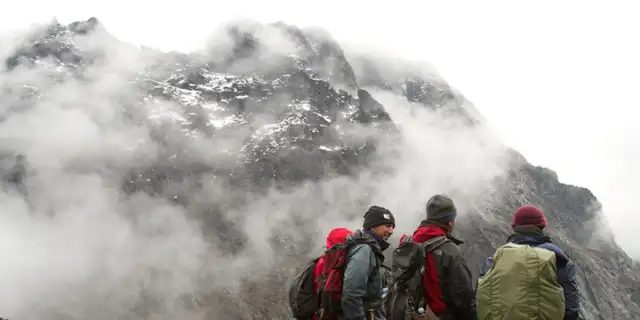
Rwenzori Mountain climbing safaris on a vacation. For any hiker desiring mountain climbing safaris in Uganda, you need to climb the Rwenzori Mountains on your vacation. One of the best places to go mountaineering in all of Africa is the Rwenzori Mountains. The Rwenzori Mountains are in western Uganda, on the border with Congo. They are 5,109 meters above sea level, with Mount Stanley being the highest point and the Rwenzoris' roof. Rwenzori Mountain is known as one of the best places to go mountain climbing in Africa. You can climb snow-covered hills and walk on equatorial glaciers that form the Nile's highest and most interesting source.
There are 6 separate mountains in the Rwenzori Mountains. They are Mount Stanley, Mount Speke, Mount Baker, Mount Emin, Mount Gessi, and Mount Savioa. At 5109 meters, Margherita Peak is the highest point on Mount Stanley. It is also the third highest point in Africa. There are 2 parts of Rwenzori: one is in DR Congo and the other is in Uganda. The Ugandan part was named the Rwenzori Mountains National Park in 1991 and was named a World Heritage Site in 1994. It is mostly accessible through Kasese town, which is next to Queen Elizabeth National Park. You might also see different kinds of mammals and birds while on Rwenzori mountain climbing safaris in Uganda.
Day 1: Nyakalengija (1,615 meters above sea level) – Nyabitaba Camp
The center circuit starts at Nyakalengija, where the Rwenzori Mountaineering Services office is located. You should get there early in the morning so that you have time to rent gear and meet your guides and helpers. The trail starts in farmland and goes through it until it reaches the park boundary. From there, it goes through a thick forest along the Mubuku River, crossing a branch of the Mahoma River on its way. Then, it starts a long, steep climb up a huge hill to get to Nyabitaba hut. You might listen to the voices of chimpanzees and see black-and-white colobus, blue monkeys, and the brightly colored Rwenzori turraco on this part of the trip. In general, the walk takes between 6-7 hours.
Day 2: Nyabitaba to John Matute Camp – 3,505 meters
From Nyabitaba, take the path that goes through the forest and drops down to the Kurt Shafer Bridge, which is right where the Mubuku and Bujuku rivers meet. As you go through the bamboo forest, you'll have to walk across a long, tiring stretch of mossy rock. You can see Mount Stanley and Mount Speke from the Nyamuleju rock shelter. After that, you'll be in the area with the big heather, lobelia, and groundsel. After a long, tiring walk through the bog, finally make it to John Matte Hut in time for dinner and the night. In general, this part of the Rwenzori Mountains takes 7-8 hours.
Day 3: John Matte – Bujuku Camp (3,962 meters above sea level)
From John Matte Hut, the path goes down and across the Bujuku River. It then goes into Lower Bigo Bog, which is where the giant lobelias live. After jumping from tussock to tussock, the bog is finally crossed, but not before the feet try some of the freezing ooze below. There are views of Mt. Baker to the south and Mt. Stanley to the west from Bujuku Lake, which is made up of the upper Bigo Bog. It is in a small valley below Stuhlmann Pass, in the shade of Mount Baker and Mount Speke. This is a great place to stay. People who are trying to reach the tops of Mount Stanley and Mount Speke can use this camp to get used to the altitude. Dinner at Bujuku hut and a night there. Generally, the hike takes between 4-5 hours.
Day 4: Bujuku – Mt. Speke – Bujuku
Here you will start the trek to Victorio Emanuele peak early in the morning. It goes through Studlmann's Pass (4,192 meters above sea level) and has amazing views of Virunga National Park in the Democratic Republic of the Congo. This trek takes between 4-5 hours to get to the top.
Get ready to go down to Bujuku camp from Victorio Emanuele, where you can see Mount Baker, the Margherita and Albert peaks on Mount Stanley, and Bujuku valley and lake. You will spend the night at Bujuku Camp. This trekking adventure generally takes usually takes between 3 and 4 hours to go down.
Day 5: Bujuku to Elena Camp (4,541 meters above sea level)
As you leave Bujuku, the trail goes through more bog, up the steep hills west of the lake, and through the magical forest of Groundsel Gully. On a steep trail over big rocks, go to the right to reach Elena Hut and Mount Stanley. The trail on the left leads to Scott-Elliot Pass and down to Kitandara Lakes, and the path on the left leads to Kitandara Hut for people who aren't climbing Margherita Peak. Those who are climbing the peak will eat dinner and spend the night at the cool and icy Elena Hut. This part of the Rwenzori Mountains generally takes 5-6 hours.
Day 6: Elena Hut – Margherita peak (5,109 meters above sea level) – Kitandara Camp
You try to climb Mount Stanley's highest peak, Margherita, very early in the morning. About 4 to 5 hours of climbing are needed to reach the top of Margherita. This depends on the weather and how fast you go. This tough hike goes over 3 glaciers, rough rocks, ice, and open places that can be seen from all sides. Cross the Stanley Plateau and continue the climb by climbing up on the glaciers. As you get used to the fog, altitude sickness, and cool weather, you can scramble to the top of Margherita, the Rwenzori's highest peak. It will take you about 2-3 hours to get back to Elena Hut from Margherita Peak.
Go down to the Scott-Elliot pass (4,372 meters asl.) after lunch at the Elena hut. From there, you can see Bujuku Lake and Mount Speke in a beautiful way. After that, the trail takes you through a mountain area with few plants and big rocks. It then goes down past the Kitandara Lakes to the Kitandara camp, where you'll spend the night. This part of the Rwenzori Mountains usually takes between 3-4 hours to descend.
Day 7: Kitandara to Mt. Baker (4,843 meters) and back to Kitandara
The climb starts early in the morning at Kitandara Camp and goes through Fresh Field Pass (4215 meters asl), where you can see DR Congo, to reach Edward Peak. It takes about 5-6 hours to get to ascend.
From Edward Peak, go down to Fresh Field Pass, and then go back to Kitandara Camp for the night. This usually takes between 3 and 4 hours to go down.
Day 8: Guy Yeoman – Kitandara
From Kitandara, take the trail that goes steeply up the headwall. The trail spreads out from the base of Mount Baker and goes along the south side of the mountain to Fresh Field Pass, which is 4282 meters above sea level. From here, you can see Mount Stanley in the north and the Congo to the west.
You can start the long high alpine mossy from the pass. After that, start going down through steep, rocky paths to the rock shelter at Bujongolo, which was the base camp for the famous expedition led by the Duke of Abruzzi in 1906. Spend the night at Guy Yeoman Camp. Generally, this trek takes between 6-7 hours.
Day 9: Guy Yooman to Nyabitaba to Nyakalengija (1615 meters above sea level)
The path goes down the rocks of Kichuchu below Guy Yeoman. The muddy road goes past Kichuchu and twice crosses the Mubuku River. It then goes through a bamboo forest and climbs down to Nyabitaba to finish the circuit. Keep going down from Nyabitaba Camp until you reach the base camp at Nyakalengija in the evening. It takes 7–8 hours to descend.
The best time to climb the Rwenzori Mountains
Due to the fact that the Equator runs through East Africa, the weather here is usually temperate. Mountain climbing safaris and in particular trekking the Rwenzori Mountains is best done during the dry season, when the trails are a bit dry and the hikes are easy and available. The roads that lead to the mountains are also dry during this time, from June to September and from December to February every year. However, because these are mountains and they are high above sea level, it will still rain and be slippery at the top.
What to bring and how to pack for Rwenzori Mountain climbing safaris in Uganda
When preparing for mountain climbing safaris in Uganda, it's advisable to pack strategically for varying conditions and terrains. For the Rwenzori mountains safaris, opt for silk clothes, quick-drying attire, and long-sleeved shirts that wick away moisture, considering the frequency of rain and high temperatures. Tracking demands lightweight, flexible pants, while sturdy camping boots, preferably waterproof, are essential for navigating wet and uphill terrain comfortably. Sandals offer relief after strenuous activities, and a rain jacket is indispensable for protecting gear.
Stocking up on socks is crucial for moisture absorption and warmth. Don't forget a spacious backpack to accommodate essentials like a sleeping bag, tent, snacks, and a water purifier for mountain streams. Sun protection items such as sunscreen, a hat, and sunglasses are vital, as is a first aid kit for emergencies. Equip yourself with a headlamp for navigating in the dark and a towel for staying dry and clean. Additionally, ensure your camera is stocked with extra batteries and memory cards to capture memorable moments throughout the journey.
Mountain climbing safaris in Uganda and particularly trekking the Rwenzori Mountains is just one of many safaris you can do in Uganda, either before or after the hike. Some of these safaris include wildlife safaris, gorilla trekking safaris, chimpanzee trekking safaris, or golden monkey trekking safaris, and so on.
Ready to plan your safari?
Talk to a Lamz Tours specialist and get a tailor-made quote.
Make an enquiry