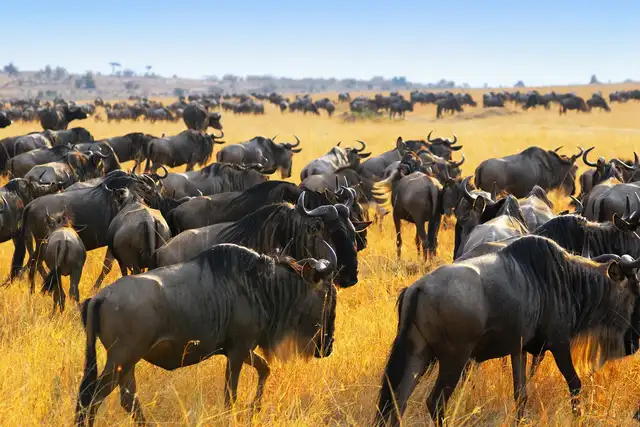
Because the herds move between countries, the honest answer is that both are essential parts of one story. The Great Migration takes place annually between Serengeti National Park in Tanzania and Masai Mara National Reserve in Kenya, and the better base for you depends on your dates, your budget, and the kind of safari you want. Here is how the two compare.
In short: Tanzania's Serengeti hosts the herds for longer, while Kenya's Masai Mara delivers concentrated action from July to October. Many travelers combine both.
Popular Great Migration Safari Packages
Kenya or Tanzania: Where Is the Best Place to Watch the Great Migration?
1. Herd Numbers and Scale
In terms of numbers, the Serengeti hosts a larger population of over 1.5 million wildebeest, while the Masai Mara harbors around 1.3 million. The wider figure quoted for the whole ecosystem is over two million wildebeest, zebras, and other grazers, so exact counts vary by source and by year.
2. Timing: A Longer Window in Tanzania
The Serengeti hosts the migration for longer periods, from December to July, while the Masai Mara sees the herds from about July to October. If your dates are flexible and you want the Kenyan spectacle, aim for July to October; if not, the Serengeti gives you more months of choice.
3. Size and Feel: Compact Mara vs Vast Serengeti
A Masai Mara safari offers a more concentrated experience in 1,510 square kilometres, with higher predator density, meaning less driving between sightings. The Serengeti spans 14,763 square kilometers, and it feels more remote, with fewer vehicles crowding around each lion sighting.
4. Crowds and Access
The trade-off for the Mara's convenience is people: the popularity of the Masai Mara can lead to overcrowding during peak seasons. On the other hand, the Mara is often easier to access, with shorter travel times and more compact viewing areas, making it a strong choice for shorter trips.
5. Getting There
To reach the Mara, you travel into Nairobi and take a scheduled flight into the Mara Reserve. For the Serengeti, you typically fly into Kilimanjaro or Arusha and continue by road or domestic flight. Where you choose to watch the migration determines your entry point and your itinerary length.
6. The Best of Both: A Mara-Serengeti Combination
Many travelers do not choose at all. The Mara-Serengeti combo is ideal for the Great Migration and avoids long drives, and Isebania/Sirari is the most efficient border crossing for linking the two. Itineraries like the 8-day Masai Mara and Serengeti tour or the 12-day Kenya and Tanzania wildlife safari are built exactly this way, so that if you miss the herds on one side, you can "see the herds in the Serengeti" on the other.
Weather and Climate
Both destinations are warm and dry from June to October, with the Masai Mara noted for similar temperatures with cooler nights. Pack warm layers for early morning game drives at either park.
Best Time to Visit
For Kenya, July to October is peak for the Great Migration and Big Five viewing. For Tanzania, the herds are present much of the year, with calving in January to March and river crossings from July to October in the north.
How to Get There
Fly into Nairobi (NBO) for the Masai Mara or Kilimanjaro International (JRO) for the Serengeti, and use domestic flights or the Isebania/Sirari border to move between the two. Visa fees are around 50 US dollars for Kenya, or 51 if applied for online, and 50 US dollars for Tanzania (100 for American or Irish passport holders).
Health and Safety Tips
A yellow fever vaccination is commonly required or recommended depending on your routing into Kenya or Tanzania, and malaria risk exists across most safari areas, so discuss prophylaxis with your doctor before travel. Kenya and Tanzania require separate visas, so confirm entry rules early, and carry comprehensive travel insurance covering trip cancellation and medical evacuation.
Ready to plan your safari?
Talk to a Lamz Tours specialist and get a tailor-made quote.
Make an enquiry