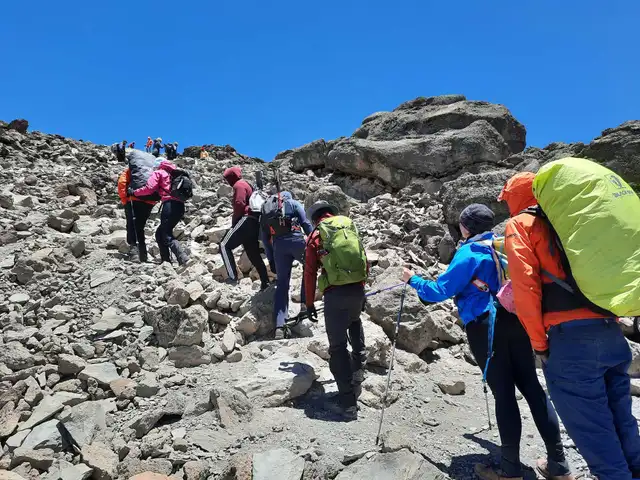
A Tanzania Safari that only focuses on the northern circuit misses the mountain that defines the country's skyline. Hidden within Kilimanjaro National Park is a trek that requires no technical climbing skills but demands respect for altitude, endurance, and preparation.
On a Tanzania Safari, understanding the difficulty of this climb—from the physical demands of summit night to the altitude risks that turn back thousands each year—shows you that reaching Uhuru Peak is less about athletic ability and more about choosing the right route and pacing yourself. Whether you take the popular Machame or the highly successful Lemosho, your preparation and route choice add strategy to your adventure. Many Tanzania Safari itineraries now include a Kilimanjaro extension, proving that the country's appeal goes far beyond the savannah.
Popular Lamz Tours and Travel Tanzania Safari Packages
7 Day Climbing Kilimanjaro via the Machame Route
8 days kilimanjaro Climbing Safari Lemosho Route Mount
5 Days Kilimanjaro climb via Marangu route
8 Days Ultimate Kilimanjaro safari summit Machame route
10-Days Best Tanzania Wildlife Safari & Hiking Kilimanjaro Marangu Route
7 Days Climbing Kilimanjaro Safari and Nakuru Kenya Safari
5 Days Tanzania Nyerere Park and Zanzibar beach holidays combined safari
How Hard Is It to Climb Mount Kilimanjaro?
Tanzania Safari: No Technical Skills Required — But It Is Still Hard
On a Tanzania Safari, the Machame Route and other Kilimanjaro trails are often described as "trekking peaks" rather than technical climbs. You do not need ropes, ice axes, or crampons to reach the summit . The paths are well-established, and the vast majority of your gear is carried by porters .
But this accessibility is misleading. Kilimanjaro rises from the Tanzanian lowlands to 5,895 metres with no foothills, meaning your body faces a rapid and sustained exposure to altitude . National Geographic describes the experience as "a long, high-altitude trek" rather than a climb, but one that still demands "basic fitness and fortitude" .
The real difficulty lies not in the trail itself but in the thin air, the cold, and the duration. On summit night alone, you will walk uphill for 6 to 8 hours in temperatures of −10°C to −20°C, then descend for another 4 to 6 hours .
Tanzania Safari: Altitude Is the Biggest Challenge
On a Tanzania Safari, the Lemosho Route is recommended precisely because it gives your body the most time to adjust. Altitude sickness is the leading cause of failure on Kilimanjaro, not lack of fitness .
At Uhuru Peak, there is roughly 50% of the oxygen available at sea level . Symptoms of Acute Mountain Sickness (AMS)—headaches, nausea, fatigue, dizziness—are common. One study of trekkers on the Marangu Route found that 77% developed AMS, and only 61% reached the summit .
The UIAA warns that of the 40,000 visitors Kilimanjaro attracts each year, between 50 and 75 percent turn back before reaching the summit . This is why route choice and acclimatisation matter more than raw fitness.
Tanzania Safari: Route Choice Determines Your Difficulty
On a Tanzania Safari, the Marangu Route is the shortest and cheapest but has the lowest success rate, often cited at 50–60% . Its rapid ascent profile gives your body little time to adapt.
The Machame Route on a 7-day itinerary reaches 85% success, but the 6-day version sees significantly higher turnaround rates . The extra day makes a meaningful difference to acclimatisation.
The Lemosho Route on 8 days achieves 90% or above and is widely recommended for first-time trekkers . The Northern Circuit at 9–10 days reaches 95%+, the highest on the mountain .
Tanzania Safari: Physical Demands and Fitness Requirements
On a Tanzania Safari, you will walk 6 to 8 hours a day for 6 to 8 consecutive days, carrying a 6–8 kg daypack . Summit night demands a 14–18 hour day of sustained effort .
Fitness benchmarks suggest that if you can complete a 5-hour hike with 1,000 metres of elevation gain and feel tired but functional, you are in the right range . A 12–16 week training plan is recommended, focusing on long, slow efforts rather than interval training .
Adventure Consultants note that "plenty of marathon runners fail to summit" because pure cardiovascular fitness is necessary but not sufficient . The descent after summiting—nearly 4,000 metres over two days—is brutal on knees and quads, and most climbers underestimate it .
Tanzania Safari: The Mental Challenge of Summit Night
On a Tanzania Safari, summit night is described by guides with "gentle understatement" as "not a good night" . You wake around midnight, eat a small meal in the cold, and begin climbing in darkness with only your headtorch and the heels of the person in front to guide you .
National Geographic's writer described the experience as "painfully slow and excruciatingly dull," with the brain turning to "sludge" from the altitude . The final push from Stella Point to Uhuru Peak is where most people who turn back, turn back .
Tanzania Safari: Best Time to Climb
On a Tanzania Safari, the best time to climb Kilimanjaro is the dry seasons from June to October and December to February, when skies are clearer, trails are drier, and summit conditions are more favorable . The wet seasons (March to May and November) bring snow, ice, and muddy trails, making the climb more challenging, though crowds are smaller and some operators offer lower rates.
Why Book with Lamz Tours and Travel for Tanzania Safari and Kilimanjaro
Booking your Tanzania Safari with Lamz Tours and Travel ensures your Kilimanjaro climb is seamless and unforgettable. Lamz Tours and Travel operates across multiple African countries, including Tanzania, Kenya, Uganda, Rwanda, Morocco, South Africa, Botswana, and Namibia. Our local guides know every route on the mountain—from the Marangu huts to the Lemosho rainforest to the Northern Circuit's remote slopes. We handle everything, including park fees, route selection, mountain crew arrangements, airport transfers, and pre-climb accommodation. You focus on the summit. We handle everything else.
Ready to plan your safari?
Talk to a Lamz Tours specialist and get a tailor-made quote.
Make an enquiry