The Rwanda's top 13 primates from mountain gorillas to owl-faced monkeys on a safari across Volcanoes, Nyungwe and Akagera National Parks.
Have you ever imagined walking through misty mountain forests and locking eyes with a silverback gorilla, or catching a flash of golden fur as playful monkeys leap overhead? A Rwanda primate safari brings you face-to-face with Africa’s most iconic and rare primates in lush, diverse habitats. From the dense bamboo trails of Volcanoes National Park to the towering canopy of Nyungwe Forest, Rwanda offers a thrilling blend of adventure, biodiversity, and conservation. Track mountain gorillas with expert guides, watch chimps vocalize in social chaos, or spot elusive nocturnal species on guided night walks. This isn’t just a wildlife tour it’s a trip into behavior, ecology, and connection. Whether you're a first-time traveler or a seasoned explorer, a Rwanda primate safari lets you witness over 13 primate species, each with its own charm, habitat, and rhythm. With world-class lodges, breathtaking landscapes, and unforgettable encounters, Rwanda sets the gold standard for primate trekking experiences. Prepare to be inspired, awed, and transformed by nature’s most intelligent creatures
top Rwanda primate safari packages
2 day Gorilla trekking safari in Rwanda
2 Days Nyungwe Chimpanzee and Canopy Walk Safari in Rwanda
3 Days Gorilla and Golden Monkey Trekking Rwanda Tour
3 Days Safari to Rwanda and Uganda Gorilla Trekking
4 Days Luxury Gorilla Tracking Rwanda Tour
4 Days Primate Safari to Rwanda with Gorillas and Chimps
5 Days in Rwanda with Gorillas and Akagera Big Five Safari
8 Days Rwanda Cultural and Primate Experience
3Days Rwanda Safari Holiday with Gorilla Trekking
12 Days Rwanda Safari in Volcanoes, Nyungwe and Akagera National Park
Best 13 Rwanda primates to see on your Rwanda primate safari
Mountain Gorillas
Spotting mountain gorillas is the crown jewel of any Rwanda primate safari. Found in Volcanoes National Park, these magnificent creatures share about 98% of our DNA and live in structured family groups led by silverbacks. Trekking to see them is a transformative experience, as you're immersed in misty bamboo forests while observing human-like behaviors and interactions. Rwanda primate safari operators organize guided hikes year-round, with dry seasons from June to September and December to February being the most comfortable. Spending an hour with gorillas, watching them feed, groom, or play, is one of Africa’s most powerful wildlife encounters.
Golden Monkeys
Golden monkeys add a splash of color and comedy to your Rwanda primate safari. These playful, orange-furred monkeys are endemic to the Virunga volcanic region and often found within the same forest zones as gorillas in Volcanoes National Park. Their social antics, swift movements, and expressive faces make them fascinating to observe. Trekking to see golden monkeys is usually easier and shorter than gorilla hikes, making it a perfect complement to your Rwanda primate safari. Watching troops leap between bamboo stalks while nibbling on leaves and insects adds lighthearted joy to the primate-focused tour
Chimpanzees
Chimpanzees bring electrifying energy to Rwanda primate safari adventures, especially in Nyungwe Forest National Park. With a 90% success rate for sightings, trekkers often witness incredible moments like chimps vocalizing, grooming, or hunting colobus monkeys. These primates display high intelligence and social complexity, offering insight into human evolutionary roots. Rwanda primate safari guides navigate dense montane forests during early morning treks, with dry seasons improving trail conditions. Spotting chimpanzees in their natural habitat isn’t just exciting it’s a window into the wild behaviors of our closest living relatives, making this experience deeply engaging and educational.
Angolan Colobus monkeys
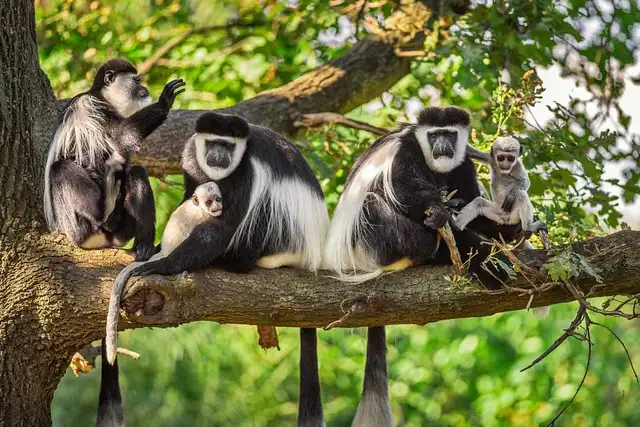
Angolan colobus monkeys deliver striking visuals on a Rwanda primate safari, thanks to their flowing black-and-white fur and graceful movements. Nyungwe Forest houses a "Colobus Army" of over 500 individuals, often seen near Uwinka Visitor Center. Their long tails and synchronized group behavior make them mesmerizing to watch, especially as they leap through trees in coordinated waves. Rwanda primate safari visitors enjoy observing these peaceful leaf-eaters, whose quiet nature contrasts with the louder chimps and mangabeys. The colobus monkeys showcase the diversity of Rwanda's primates and are a must-see for photography and primatology enthusiasts.
L’Hoest’s Monkey
One of the shyer species encountered on a Rwanda primate safari, L’Hoest’s monkeys are recognized by their white beards and stealthy terrestrial movement. Found in both Nyungwe and Volcanoes National Parks, they often travel alone or in small female-led groups. Spotting them requires patience and sharp eyes, as they blend easily with the forest floor and tend to avoid large groups. Rwanda primate safari guides offer insights into their elusive behavior and conservation challenges. Seeing L’Hoest’s monkeys adds a rare and rewarding element to your primate checklist, especially for those drawn to quieter, less-studied species.
Olive Baboons
Olive baboons inject energy into the savanna side of your Rwanda primate safari, particularly in Akagera National Park. These large, social primates form troops of up to 100 individuals and are easily seen on game drives. Known for their opportunistic feeding and cheeky behavior, baboons often interact with other animals and occasionally approach vehicles. While not as forest-dwelling as gorillas or chimpanzees, olive baboons bring their own charm to Rwanda primate safari itineraries. Watching them groom, forage, or navigate troop dynamics gives travelers a broader understanding of primate social structures beyond mountain forests.
Grey-Cheeked Mangabey
Grey-cheeked mangabeys may be less famous, but they’re a standout during forest treks on a Rwanda primate safari. Found in Nyungwe Forest, these medium-sized primates sport shaggy fur, expressive white eyelids, and make distinctive "whoop-gobble" vocalizations. Their loud social behavior and agile movements make them exciting to track. Rwanda primate safari guests often hear them before seeing them, with guides skilled at locating family groups deep in the forest. Observing these mangabeys adds sonic texture to the safari experience and introduces visitors to one of Rwanda’s more eccentric and entertaining forest dwellers.
Vervet Monkeys
Vervet monkeys bring humor and mischief to your Rwanda primate safari, thanks to their playful personalities and distinctive blue coloring. Found in both Akagera and Nyungwe, they’re common and easily photographed. Vervets often interact with lodges and campsites, sometimes becoming bold around unattended snacks! While they may lack the rarity of gorillas or chimps, they enrich your Rwanda primate safari with lively behavior and fascinating facial expressions. Watching these monkeys leap between branches or playfully chase one another helps balance the drama of predator-rich safari zones with lighthearted charm.
Dent’s Mona Monkey
Small and discreet, Dent’s mona monkeys add subtlety to any Rwanda primate safari. Found in Nyungwe Forest, these monkeys often travel in mixed-species groups and are best identified by a distinctive orange patch on their back. Though less commonly seen than blue or golden monkeys, their unique markings and delicate features make them a rewarding find for dedicated primate watchers. Rwanda primate safari guides point out their quiet feeding habits and social interactions, offering insights into lesser-known species. Observing Dent’s mona monkey underscores the rich variety of primates dwelling in Rwanda’s pristine montane forests.
Blue Monkeys
Blue monkeys offer dazzling silvery-blue fur and melodious calls, making them a visual and acoustic highlight of your Rwanda primate safari. Commonly seen near golden monkeys in Nyungwe and Volcanoes National Parks, they’re noisy and social, often forming large troops. Their antics in the canopy provide endless entertainment, especially during early morning treks. Rwanda primate safari travelers frequently encounter these monkeys while tracking other species, making them a welcome bonus. Their dynamic movements and group interactions showcase vibrant primate ecology and emphasize Rwanda’s importance as a sanctuary for multiple monkey species.
Potto
Pottos are the cryptic stars of night walks in Nyungwe, offering a mysterious experience on any Rwanda primate safari. As slow-moving nocturnal primates with big, reflective eyes and stealthy behavior, they’re difficult to spot without experienced guides. Found deep within forest trails, pottos use silent movements and low-energy climbing to hunt insects and avoid predators. Rwanda primate safari travelers seeking a challenge love these moonlit sightings, which require silence, patience, and a bit of luck. Encountering a potto is a rare badge of honor for primate enthusiasts focused on elusive species and nighttime exploration.
Demidoff’s Dwarf Galago
These tiny, bug-eyed bushbabies add spring-loaded excitement to night treks during your Rwanda primate safari. Found in Nyungwe Forest, Demidoff’s dwarf galagos leap impressive distances between branches and emit high-pitched vocalizations that echo through the dark. Despite their miniature size, they’re energetic and fun to observe, often hunting insects or marking territory with scent glands. Rwanda primate safari participants find galagos to be surprisingly expressive and agile, making them one of the most charming nocturnal primates. Their big eyes and sudden movements create unforgettable sightings in the quiet canopy of Rwanda’s moonlit forests.
Owl-Faced Monkey
The owl-faced monkey is the elusive grail of any Rwanda primate safari. Possibly found in Volcanoes National Park but more common across the border in the Congo, this rare monkey features a striking striped face that resembles an owl’s mask. Its secretive habits and remote habitat make sightings extremely rare, sparking excitement among primatologists and wildlife lovers. Rwanda primate safari operators occasionally search for evidence of these monkeys, though confirmed sightings are scarce. Spotting one would be an extraordinary moment, placing you among the few who’ve glimpsed this mysterious and legendary forest phantom
Best time to go for Rwanda primate safari
Dry Seasons form June–September and December–February
The dry seasons are considered the optimal time for a Rwanda primate safari, offering easier trekking conditions across Volcanoes, Nyungwe, and Akagera National Parks. With minimal rainfall, trails are firmer and visibility improves, allowing for smoother hikes and more successful encounters with gorillas, chimpanzees, and monkeys. June to September aligns with summer holidays and high gorilla activity, while December to February provides cooler temperatures and fewer tourists. Dry leaves also make it easier to hear and spot primates. Travelers planning a Rwanda primate safari during these months can expect rewarding treks and more reliable schedules for park activities.
Green Season from March–May
Though wetter, the green season brings vibrant landscapes and quieter trails, making it an underrated window for a Rwanda primate safari. Rainfall transforms the forest into a lush paradise, ideal for photography and birdwatching. While trekking may be muddier and slightly more challenging, the reduced number of visitors creates a more intimate primate experience. Park permits are often easier to secure, and accommodation prices tend to be lower. For travelers who appreciate nature’s full bloom and fewer crowds, the green season offers a refreshing and serene Rwanda primate safari alternative with plenty of wildlife still on display
How to get there to see primates on Rwanda primate safari.
To begin your Rwanda primate safari, fly into Kigali International Airport (KGL), the country’s main gateway. From Kigali, it’s a scenic 2–3 hour drive to Volcanoes National Park for mountain gorilla and golden monkey trekking. For chimpanzee tracking, head southwest to Nyungwe Forest National Park, which takes about 5–6 hours by road or a short domestic flight. Most Rwanda primate safari operators offer private transfers, guided tours, and permit assistance to streamline logistics. Booking through a trusted company ensures smooth access to parks, early morning trek coordination, and comfortable accommodation near trailheads. With proper planning, your Rwanda primate safari begins with ease and leads to unforgettable wildlife encounters
Top places for Rwanda primate safari
Volcanoes National Park
Volcanoes National Park is the crown jewel of any Rwanda primate safari, offering world-renowned gorilla trekking with a 98% sighting rate. Home to ten habituated mountain gorilla families, it also hosts playful golden monkeys and the elusive owl-faced monkey. The park’s proximity to Kigali makes it easily accessible, and its rich conservation history includes Dian Fossey’s Karisoke Research Center. Trails are best explored during the dry seasons from June to September and December to February. A Rwanda primate safari here promises intimate encounters with great apes in misty bamboo forests, making it a bucket-list destination for wildlife lovers.
Nyungwe Forest National Park
Nyungwe Forest is a biodiversity hotspot and a highlight of any Rwanda primate safari. With over 13 primate species, it offers thrilling chimpanzee trekking with a 90% success rate, plus sightings of Angolan colobus monkeys in massive supergroups. L’Hoest’s monkeys, grey-cheeked mangabeys, and nocturnal species like potto and dwarf galagos add to the diversity. The park’s canopy walkway provides aerial views of monkeys in action. Less crowded than Volcanoes, Nyungwe is ideal for immersive forest experiences. Dry seasons from June to August and December to February offer the best trekking conditions for a rewarding Rwanda primate safari.
Gishwati-Mukura National Park
Gishwati-Mukura is a rising star on the Rwanda primate safari circuit, offering a more wild and authentic experience. Newly habituated chimpanzees roam its montane forests, alongside blue monkeys and vervet monkeys. The park’s fragmented landscape is undergoing reforestation, supported by community-based tourism initiatives. Visitors enjoy guided hikes, birdwatching, and cultural encounters with locals. With fewer tourists, Gishwati-Mukura provides a peaceful alternative to busier parks. The best time to visit is June to October, avoiding the heavy rains of April and May. A Rwanda primate safari here supports conservation while delivering raw, intimate wildlife moments.
Akagera National Park
Akagera blends classic savanna safaris with primate sightings, making it a unique stop on a Rwanda primate safari. Olive baboons and vervet monkeys are commonly seen near lakeshores and open plains. The park also hosts the Big Five lions, rhinos, elephants, leopards, and buffalo creating a diverse wildlife experience. Boat safaris on Lake Ihema reveal hippos, crocodiles, and monkeys drinking at the water’s edge. Akagera’s dry season from June to September is ideal for spotting wildlife in concentrated areas. For travelers seeking both primates and big game, this park adds variety and excitement to any Rwanda primate safari.
Buhanga Eco-Park
Buhanga Eco-Park is a mystical forest with cultural and ecological significance, perfect for a quiet Rwanda primate safari. Located near Volcanoes National Park, it’s home to blue monkeys and shy L’Hoest’s monkeys, often seen during guided nature walks. The forest’s sacred history includes ancient coronation rituals of Rwandan kings, adding depth to the experience. Trails wind through lava rock formations and towering trees, offering serene wildlife encounters. Though small, Buhanga’s biodiversity and cultural richness make it a rewarding detour. A Rwanda primate safari here combines nature, history, and tranquility in one enchanting forest escape.
What to carry for Rwanda primate safari.
For a successful Rwanda primate safari, pack lightweight, breathable clothing in neutral tones to blend into forest environments long sleeves and pants help protect against insects and scratches. Sturdy hiking boots with good grip are essential for trekking in Volcanoes or Nyungwe forests. Don’t forget a rain jacket, as weather can shift quickly, especially in mountainous areas. Bring insect repellent with DEET, sunscreen, a wide-brimmed hat, and sunglasses for sun protection. A camera with extra batteries and memory cards is a must for capturing gorillas and chimps in action. Include a small daypack, reusable water bottle, travel adapter (Type C or J), and any personal medications. Your Rwanda primate safari will be smoother with thoughtful packing that balances comfort, safety, and preparedness
Best places to stay for Rwanda primate safari
For an unforgettable Rwanda primate safari, top accommodations include luxurious lodges like Bisate Lodge and Sabyinyo Silverback Lodge near Volcanoes National Park for mountain gorilla and golden monkey trekking. In Nyungwe Forest, One&Only Nyungwe House offers upscale comfort and direct access to chimpanzee hikes and canopy walks. For a Big Five and primate combo, stay at Magashi Camp or Ruzizi Tented Lodge in Akagera National Park. Budget and mid-range options are also available near park gates for convenience and affordability. Wherever you stay, these locations elevate your Rwanda primate safari with great hospitality, expert guides, and close proximity to incredible wildlife encounters
Why book Rwanda primate safari with Lamz Tours and Travel
Booking your Rwanda primate safari with Lamz Tours and Travel means choosing a company that blends deep local expertise with personalized service and a strong conservation ethic. Our itineraries are crafted to include unforgettable gorilla trekking in Volcanoes National Park, chimpanzee tracking in Nyungwe Forest, and golden monkey encounters all guided by certified experts who understand primate behavior and forest ecology. Lamz Tours and Travel handles everything from permits to luxury lodge bookings, ensuring a seamless experience. What sets them apart is ourr commitment to responsible tourism: they work closely with local communities and conservation groups, so your Rwanda primate safari directly supports wildlife protection and sustainable development
Ready to plan your safari?
Talk to a Lamz Tours specialist and get a tailor-made quote.
Make an enquiry