Experience the top ten must see bird species in Uganda on Uganda safaris, from the iconic shoebill stork to the rare African green broadbill and the dazzling great blue turaco.
A Uganda safari is famous for gorillas, chimpanzees, and the Source of the Nile. But for bird lovers, Uganda is paradise. Over 1,090 bird species live here. That is more than most countries in Africa, and nearly half of all bird species on the continent. On a Uganda safari, you can see colorful turacos, giant shoebills, and rare birds found nowhere else in the world. The best part? You do not need to be a hardcore birder to enjoy them. The birds are everywhere, from the rainforest canopy to the papyrus swamps. On a Uganda safari, they add color, sound, and life to every game drive, boat cruise, and forest walk. Here are the top ten must see bird species in Uganda on Uganda safaris.
Popular Uganda Safari Packages
Best 10 Must See Bird Species on Uganda Safaris
1. Shoebill Stork
On a Uganda safari, this is the bird everyone wants to see. The shoebill stork is prehistoric, rare, and unforgettable. Its massive shoe-shaped bill is unlike any other bird on earth. Its body is blue-grey, its eyes are yellow, and it stands as still as a statue for hours. On a Uganda safari, you will see them in papyrus swamps and wetlands, waiting to ambush lungfish and frogs. They are endangered and shy. The best place to see them is Mabamba Swamp on Lake Victoria, as well as Murchison Falls National Park and Semliki Wildlife Reserve. You need a good guide and a bit of luck. Seeing a shoebill in the wild is a lifetime highlight. On a Uganda safari, this bird is worth the entire trip.
2. African Green Broadbill
On a Uganda safari, the African green broadbill is a special treat for serious birders. It is one of the rarest and most sought-after birds in Africa. Its body is bright green with a black head, yellow throat, and blue wing patches. On a Uganda safari, you will see it only in a few forests in southwestern Uganda. It lives in dense rainforest and is notoriously difficult to spot. Bwindi Impenetrable National Park is the best and most reliable place to see it. Birders travel from around the world just to add this species to their lists. On a Uganda safari, a day in Bwindi with a local guide gives you a fighting chance to see this endemic beauty.
3. Great Blue Turaco
On a Uganda safari, the great blue turaco is a showstopper. It is the largest turaco in Africa. Its body is brilliant blue and grey. Its head has a black crest, its eyes are ringed in red, and its tail is long and striking. On a Uganda safari, you will see them hopping through the forest canopy, often in noisy family groups. They eat fruit and move with surprising grace for such large birds. Kibale Forest National Park, Bwindi Impenetrable National Park, and Semliki National Park are the best places to see them. Their loud "kow-kow-kow" call often announces their presence before you see them.
4. Green Breasted Pitta
On a Uganda safari, the green breasted pitta is the holy grail for birders. It is secretive, ground-dwelling, and brilliantly colored. Its body is green on top, bright yellow and green underneath, with a blue throat and red belly. On a Uganda safari, you will see it only in a few forests in western Uganda. It hides in dense undergrowth and rarely comes into the open. Kibale Forest National Park and Semliki National Park are the best places to see it. You need patience, sharp eyes, and a guide who knows its call. Seeing this bird is a true badge of honor for any birder.
5. African Fish Eagle
On a Uganda safari, the African fish eagle is the sound of Africa. Its call is loud, haunting, and unmistakable. It echoes across lakes, rivers, and swamps. The bird has a white head, brown body, and bright yellow beak. On a Uganda safari, you will see them perched in tall trees near water. They dive to catch fish with their powerful talons. The Kazinga Channel in Queen Elizabeth National Park, the Nile River in Murchison Falls National Park, and Lake Mburo are the best places to see them. Bring binoculars. The fishing action is fast and dramatic.
6. Saddle Billed Stork
On a Uganda safari, the saddle billed stork is one of the tallest and most striking storks in Africa. It can stand over five feet tall. Its body is black and white. Its bill is red with a black band and a yellow shield that looks like a saddle. On a Uganda safari, you will see them in wetlands, floodplains, and shallow lakes. They walk slowly through the water, hunting for fish, frogs, and crabs. Murchison Falls National Park, Queen Elizabeth National Park, and Lake Mburo National Park are the best places to see them. Their size makes them easy to spot, but they are not common.
7. Papyrus Gonolek
On a Uganda safari, the papyrus gonolek is a stunning and localised bird. It is found only in papyrus swamps, and Uganda has some of the best swamps in Africa. Its body is bright crimson underneath and jet black above. Its head is black with a grey crown. On a Uganda safari, you will see it only in dense papyrus, so you often hear it before you see it. Its call is a loud, musical duet. Mabamba Swamp, the shores of Lake Victoria, and the papyrus swamps along the Nile are the best places to see it. This bird alone is worth a boat trip into the papyrus.
8. Rwenzori Turaco
On a Uganda safari, the Rwenzori turaco is a jewel of the mountains. It is found only in the Albertine Rift mountains, and the Rwenzori Mountains are the best place to see it. Its body is green, its head is blue and black, and its crest is tipped with red. On a Uganda safari, you will see it in high altitude forests between 2,000 and 3,000 meters. It moves slowly through the canopy, feeding on fruit and flowers. Rwenzori Mountains National Park and Mgahinga Gorilla National Park are the best places to see it. Its beauty rivals any bird in the world.
9. Standard Winged Nightjar
On a Uganda safari, the standard winged nightjar is a bizarre and beautiful bird. It is a nightjar, so it is active at dusk and dawn. The male has a spectacular wing display, with long, ribbon-like feathers that extend far beyond its wing. On a Uganda safari, you will see them in open woodlands, savannas, and rocky hillsides. They perch on the ground or on low branches during the day. The best time to see them is at dusk, when the males perform their display flights. Kidepo Valley National Park, Murchison Falls National Park, and Pian Upe Wildlife Reserve are the best places to see them. A good guide with a spotlight is essential.
10. Grey Crowned Crane
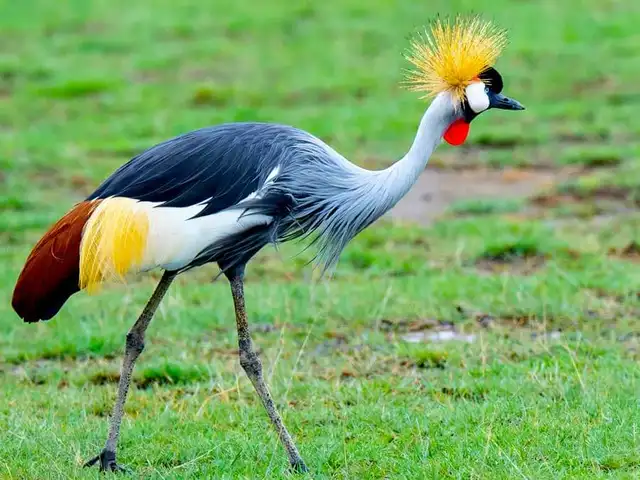
On a Uganda safari, the grey crowned crane is the national bird of Uganda, and it appears on the national flag. It is one of the most elegant birds in the world. It has a golden crown of stiff feathers on its head. Its body is grey, its wings are white and brown, and it has a bright red throat pouch. On a Uganda safari, you will see them in wetlands, grasslands, and even near farms. They dance during courtship, bowing and leaping with wings spread. They are common in many parks, but Lake Mburo National Park, Queen Elizabeth National Park, and the wetlands near Kampala are good places to look.
Best Time for Birding on Uganda Safaris
The best time for birding on a Uganda safari is the wet season from March to May and September to November. Migratory birds from Europe and Asia arrive. The landscape is green and lush, and birds are in breeding plumage. Resident birds are present year round. The dry season from June to August and December to February is still excellent, especially for waterbirds around lakes and rivers, and trails are easier to walk for forest birds like the green breasted pitta.
Best Places for Birding on Uganda Safaris
On a Uganda safari, Mabamba Swamp is the best place for the shoebill and papyrus gonolek. Bwindi Impenetrable Forest has the African green broadbill, great blue turaco, and over 350 species. Kibale Forest has the green breasted pitta and great blue turaco. Queen Elizabeth National Park has over 600 species including fish eagles, saddle billed storks, and flamingos. Murchison Falls National Park has shoebills, fish eagles, and papyrus specialists. The Rwenzori Mountains have the Rwenzori turaco and other Albertine Rift endemics. Kidepo Valley has the standard winged nightjar and dry country specialists.
What to Carry for Birding on Uganda Safaris
Pack binoculars. A good pair is essential. Bring a camera with a telephoto lens. Wear neutral colored clothing to avoid scaring birds. Bring a field guide or birding app for East Africa. Sunscreen, a wide hat, and insect repellent are important, especially for forest birding. A reusable water bottle keeps you hydrated. On a Uganda safari, a good guide makes all the difference for birding, especially for finding rare endemics like the African green broadbill and green breasted pitta.
Why Book with Lamz Tours and Travel for Birding on Uganda Safaris
Booking your birding Uganda safari with Lamz Tours and Travel ensures you see the most birds. Our guides know bird calls, habitats, and the best spots for each species, including the shoebill, African green broadbill, and green breasted pitta. We handle everything including transport, park fees, guides, accommodation, and boat trips. You just show up with your binoculars. Want to focus on the shoebill? We can do that. Want to see the African green broadbill in Bwindi? We can arrange it. Want to track the green breasted pitta in Kibale? We have the right guides. You focus on the birds. We handle everything else on your Uganda safari.
Ready to plan your safari?
Talk to a Lamz Tours specialist and get a tailor-made quote.
Make an enquiry