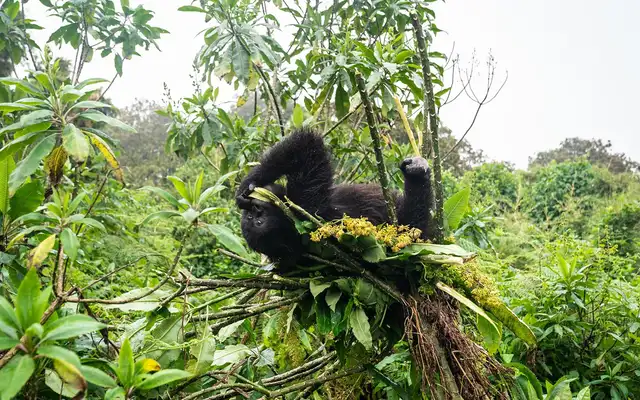
15 best facts about Rwanda mountain gorillas, covering conservation, permits, family life, diet, and tourism benefits for communities and wildlife.
Wondering why Rwanda mountain gorillas hold such a special place in global conservation and wildlife tourism leads to an inspiring story of survival and resilience. These primates, found only in the Virunga Massif and Bwindi Forest, were once critically endangered, with fewer than 250 individuals left in the 1980s. Today, thanks to strict protection, community involvement, and carefully managed tourism, their population has grown to over 1,000. Rwanda mountain gorillas are not only a symbol of conservation success but also a reminder of how human commitment can reverse decline. Their presence in Volcanoes National Park makes Rwanda one of the best places in the world to see them, offering travelers a rare chance to witness endangered wildlife in its natural habitat.
Rwanda mountain gorillas also represent the deep connection between people, nature, and culture. Trekking to see them is more than a wildlife experience it supports local communities, funds schools and clinics, and ensures that conservation benefits everyone. Their family-oriented behavior, striking similarity to humans, and reliance on protected forests highlight the importance of safeguarding biodiversity. For travelers, the opportunity to spend even one hour with Rwanda mountain gorillas is both meaningful and impactful, combining adventure with a direct contribution to their survival
Best Rwanda gorilla safari
2 day Gorilla trekking safari in Rwanda
2 Days Nyungwe Chimpanzee and Canopy Walk Safari in Rwanda
3 Days Gorilla and Golden Monkey Trekking Rwanda Tour
3 Days Safari to Rwanda and Uganda Gorilla Trekking
4 Days Luxury Gorilla Tracking Rwanda Tour
4 Days Primate Safari to Rwanda with Gorillas and Chimps
5 Days in Rwanda with Gorillas and Akagera Big Five Safari
8 Days Rwanda Cultural and Primate Experience
3Days Rwanda Safari Holiday with Gorilla Trekking
12 Days Rwanda Safari in Volcanoes, Nyungwe and Akagera National Park
15 Days Great East African Safari (Rwanda, Uganda, Kenya and Tanzania)
The 15 Best Facts to Know About Rwanda Mountain Gorillas
They are Critically Endangered, But Making a Comeback
Rwanda mountain gorillas were once on the brink of extinction, classified as critically endangered, but conservation efforts have changed their future. In the Virunga Massif, which includes Rwanda’s Volcanoes National Park, their numbers have grown from around 240 in the 1980s to over 600 today. Combined with Uganda’s Bwindi population, the total now exceeds 1,000 individuals. This recovery is a major conservation success, showing how strict protection, anti-poaching patrols, and community involvement can reverse decline. Rwanda mountain gorillas remain endangered, but their population growth proves that tourism revenue and international support directly contribute to their survival. Visitors who trek to see them are part of this conservation story, helping ensure these primates continue to thrive in their natural habitat.
Rwanda is the Land of a Thousand Hills and Their Home
Rwanda mountain gorillas live in the Virunga Massif, a volcanic mountain chain shared with Uganda and the Democratic Republic of Congo. Within Rwanda’s Volcanoes National Park, mist-covered slopes ranging from 2,400 to 4,500 meters provide the cool, biodiverse environment they need. The rolling terrain is why Rwanda is called the “Land of a Thousand Hills,” and it creates a unique backdrop for gorilla trekking. Rwanda mountain gorillas depend on this landscape for food, shelter, and protection, making the park one of the most important habitats in the world. Visitors not only see gorillas but also experience the dramatic volcanic scenery that defines Rwanda’s identity. Protecting this environment ensures the gorillas and the country’s nickname remain closely linked for generations.
You Need a Permit to See Them And They're Pricey for a Reason
Access to Rwanda mountain gorillas requires a permit from the Rwanda Development Board, costing $1,500 per person per trek. While expensive, this fee is a deliberate conservation measure. It limits visitor numbers, reducing stress on the gorillas, while funding park protection, anti-poaching patrols, and community projects. Rwanda mountain gorillas benefit directly from this system, as local communities receive schools, clinics, and clean water funded by tourism revenue. The high cost also ensures that only serious travelers participate, keeping the experience controlled and respectful. For visitors, the permit guarantees a well-managed trek and contributes to the gorillas’ long-term survival. This model is one of the reasons Rwanda is considered a leader in conservation-based tourism.
They Live in Close-Knit, Family Groups
Rwanda mountain gorillas live in stable family groups called troops, usually consisting of 5 to 30 individuals. These groups are led by a dominant male known as a Silverback, who develops a saddle of silver hair as he matures. The troop includes adult females, their young, and sometimes younger males called Blackbacks. Rwanda mountain gorillas rely on these close-knit groups for protection, social bonding, and raising offspring. Their family structure is similar to human households, with strong relationships and cooperative care. Observing these groups during a trek highlights their social intelligence and the importance of family ties. This behavior makes them relatable to humans and emphasizes why protecting their social environment is vital for their survival.
The Silverback is the Heart of the Family
The Silverback plays a central role in the lives of Rwanda mountain gorillas, acting as leader, protector, and decision-maker. He determines when the group eats, travels, and rests, while also mediating conflicts. Rwanda mountain gorillas depend on him for safety, as he will defend his troop against threats, including rival males or predators. Despite his strength, the Silverback is often gentle with his family, showing care toward females and young gorillas. His presence ensures stability within the group, and without him, the troop would struggle to survive. Observing a Silverback during a trek reveals the balance of power and tenderness that defines gorilla society, making him the true heart of the family.
They are 98% Genetically Similar to Humans
Rwanda mountain gorillas share more than 98% of their DNA with humans, making them one of our closest relatives. This genetic similarity is visible in their expressive eyes, human-like hands, and complex social behaviors. Rwanda mountain gorillas can feel emotions such as joy, grief, and curiosity, forming strong bonds within their groups. Their intelligence is evident in how they communicate, care for young, and interact with each other. This closeness also means they are vulnerable to human diseases, which is why strict trekking rules exist. For visitors, seeing gorillas reminds us of our shared evolutionary history and the responsibility we have to protect them. Their genetic link to humans makes conservation efforts even more meaningful.
They are Primarily Vegetarian with a Tiny Twist
Rwanda mountain gorillas are mainly herbivores, feeding on leaves, stems, shoots, and fruits from over 140 plant species. Their large size requires them to spend much of the day eating to maintain energy. Rwanda mountain gorillas occasionally consume small insects like ants or snails, but this makes up only a tiny part of their diet. Their feeding habits also shape the forest, as they help spread seeds and maintain plant growth. Observing them eat highlights their peaceful nature and reliance on vegetation. For travelers, understanding their diet explains why their habitat must remain intact. Protecting forests ensures the gorillas have enough food, making conservation of their environment as important as protecting the animals themselves.
An Hour is All You Get For Their Wellbeing
Tourism rules allow visitors to spend only one hour with Rwanda mountain gorillas once a group is located. This limit protects the gorillas from stress and minimizes exposure to human diseases. Rwanda mountain gorillas are highly sensitive, and maintaining a distance of seven meters is required during treks. If visitors are sick, they cannot join, as gorillas can catch human illnesses. These strict guidelines ensure gorilla welfare comes first, even during tourism. For travelers, the hour feels short but meaningful, offering a rare chance to observe natural behavior without disrupting it. This regulation is a reminder that conservation and respect are central to gorilla tourism, keeping the animals safe while allowing people to see them responsibly.
Dian Fossey Put Them on the World's Radar
The story of Rwanda mountain gorillas gained global attention thanks to Dian Fossey, an American primatologist. She founded the Karisoke Research Center in Volcanoes National Park in 1967 and dedicated her life to studying and protecting gorillas. Rwanda mountain gorillas faced severe threats from poaching, and Fossey actively fought against it, often risking her life. Her book Gorillas in the Mist introduced the world to their plight, inspiring conservation efforts worldwide. Today, her legacy continues through ongoing research and protection programs. Visitors trekking in Rwanda often hear about her work, which remains central to the gorillas’ survival story. Fossey’s dedication transformed global awareness, making her one of the most influential figures in gorilla conservation.
Gorilla Trekking Directly Fuels Rwanda's Conservation and Communities
Tourism revenue from Rwanda mountain gorillas is a cornerstone of the country’s conservation model. A portion of each $1,500 permit funds community projects such as schools, clinics, and clean water systems. Rwanda mountain gorillas benefit because local people see direct advantages from protecting them, reducing conflict and poaching. This approach turns communities into guardians of the gorillas, ensuring long-term survival. For visitors, trekking is not just about seeing wildlife but also supporting human development. The model shows how conservation and tourism can work together, creating benefits for both animals and people. Choosing to trek Rwanda mountain gorillas means contributing to a system that protects biodiversity while improving local lives.
They Only Live in Three Countries
Rwanda mountain gorillas are found exclusively in Rwanda, Uganda, and the Democratic Republic of Congo. Within Rwanda, they inhabit Volcanoes National Park, part of the Virunga Massif. This limited range makes them highly vulnerable to habitat loss and human activity. Rwanda mountain gorillas depend on high-altitude forests, which are increasingly threatened by farming and settlement. Their restricted distribution highlights why conservation in these three countries is critical. Protecting Volcanoes National Park ensures Rwanda mountain gorillas remain a central part of the country’s biodiversity and tourism appeal.
They Cannot Survive in Captivity
Unlike other gorilla species, Rwanda mountain gorillas have never survived in zoos. Every individual lives in the wild, making conservation of their natural habitat the only way to protect them. Rwanda mountain gorillas rely on complex social structures and specific diets that cannot be replicated in captivity. This fact underscores the importance of protecting Volcanoes National Park and surrounding forests. For visitors, it means trekking is the only way to see them, adding urgency to conservation efforts.
They Have Slow Reproduction Rates
Rwanda mountain gorillas reproduce slowly, with females giving birth only once every 4–6 years. Infants are highly dependent, nursing for up to three years. This slow reproductive cycle makes population recovery challenging. Rwanda mountain gorillas are therefore more vulnerable to threats like poaching or disease, as losses take decades to replace. Conservation programs focus on protecting breeding females and young to ensure long-term survival.
They Share Their Habitat with Other Rare Species
Volcanoes National Park, home to Rwanda mountain gorillas, also shelters golden monkeys, forest elephants, and diverse bird species. This biodiversity makes the park a conservation hotspot. Rwanda mountain gorillas are the flagship species, but protecting them also safeguards many other animals. Visitors trekking gorillas often see signs of these species, adding ecological richness to the experience. This interconnected habitat shows how gorilla conservation benefits the wider ecosystem.
The First Protected Area Was Created for Them in 1925
The conservation history of Rwanda mountain gorillas dates back to 1925, when Belgian authorities established Africa’s first protected area, Albert National Park, to safeguard them. This marked the beginning of organized gorilla conservation. Rwanda mountain gorillas have since become a global symbol of wildlife protection. Today, Volcanoes National Park continues this legacy, supported by tourism revenue and international partnerships. Their protection history highlights how long-term commitment has been essential to their survival
Best time to see Rwanda mountain gorillas
The best time to see Rwanda mountain gorillas is during the dry seasons, from June to September and December to February. These months provide the most comfortable trekking conditions in Volcanoes National Park, with less rainfall, clearer trails, and better visibility. Rwanda mountain gorillas are easier to track when paths are dry, and the cooler weather at high altitudes makes the hike less strenuous. This period also coincides with peak tourism, so permits should be booked well in advance to secure availability.
The rainy seasons, from March to May and September to November, are less popular but still suitable for trekking Rwanda mountain gorillas. Trails can be muddy and more challenging, yet the forests are greener, and visitor numbers are lower, making the experience quieter. Photography can be rewarding during these months, with misty backdrops adding atmosphere. For travelers who prefer fewer crowds and don’t mind wetter conditions, this can be a good option. Regardless of season, Rwanda mountain gorillas can be seen year-round, as they do not migrate, making Volcanoes National Park a reliable destination whenever you plan your visit
How to get to Rwanda mountain gorillas
The easiest way to see Rwanda mountain gorillas is by traveling to Volcanoes National Park in the country’s northwestern region. Most visitors arrive first in Kigali, Rwanda’s capital, through Kigali International Airport. From there, it takes about 2.5 to 3 hours by road to reach the park headquarters in Kinigi, Musanze District. Transfers can be arranged through tour operators, hotels, or private drivers, and the drive itself is scenic, passing through Rwanda’s famous rolling hills. Rwanda mountain gorillas are only accessible with a trekking permit, which must be purchased in advance from the Rwanda Development Board.
Once in Kinigi, treks to see Rwanda mountain gorillas begin early in the morning after a briefing at the park headquarters. Visitors are assigned to specific gorilla families and guided by experienced rangers into the forest. Depending on the gorillas’ location, hikes can last from one to several hours, often through steep and muddy terrain. Porters are available to assist with carrying bags and navigating trails. Rwanda mountain gorillas live at high altitudes, so a reasonable level of fitness is recommended. With proper planning, reaching them is straightforward, and the experience of seeing these endangered primates in their natural habitat is considered one of the most rewarding wildlife activities in Africa
Top best parks to visit during Rwanda mountain gorillas tour
The top park to visit during a Rwanda mountain gorillas tour is Volcanoes National Park, located in the Virunga Massif. This is the only park in Rwanda where mountain gorilla trekking is possible, and it offers a unique chance to see these endangered primates in their natural habitat. The park’s misty volcanic slopes provide the perfect environment for Rwanda mountain gorillas, and treks are carefully managed to protect both visitors and the animals. Beyond gorillas, Volcanoes National Park is also home to golden monkeys, diverse birdlife, and dramatic volcanic scenery, making it a rich destination for wildlife and nature lovers. For anyone planning Rwanda mountain gorillas tours, this park is the centerpiece and the main reason travelers come to Rwanda.
Other parks in Rwanda complement the gorilla trekking experience by offering different wildlife and landscapes. Akagera National Park in the east is Rwanda’s only savannah park, where visitors can enjoy traditional safari drives with lions, elephants, giraffes, and hippos. Nyungwe Forest National Park in the southwest is famous for chimpanzee tracking, canopy walks, and its rich biodiversity of primates and birds. Together with Volcanoes National Park, these destinations create a complete wildlife circuit. Rwanda mountain gorillas remain the highlight, but combining gorilla trekking with Akagera and Nyungwe ensures travelers experience Rwanda’s full diversity, from primates in dense forests to big game in open plains
How long to spend on Rwanda mountain gorillas tour
Most travelers spend between 2 to 4 days on a Rwanda mountain gorillas tour, with one full day dedicated to trekking in Volcanoes National Park and the remaining days used for acclimatization, cultural visits, or exploring nearby attractions. Rwanda mountain gorillas trekking itself takes only a few hours, but permits are limited, and weather or gorilla movements can affect timing, so having extra days ensures flexibility. Many visitors combine gorilla trekking with golden monkey tracking, hikes to Dian Fossey’s research site, or community experiences around Musanze. For those with more time, adding Nyungwe Forest for chimpanzees or Akagera National Park for a classic safari creates a balanced itinerary. Planning at least 3 days allows travelers to enjoy Rwanda mountain gorillas while experiencing the country’s broader wildlife and culture
What is the cost to see Rwanda mountain gorillas?
The cost to see Rwanda mountain gorillas is $1,500 per person for a trekking permit, which is issued by the Rwanda Development Board and required for entry into Volcanoes National Park. This fee is deliberately set high to limit visitor numbers, reduce stress on the gorillas, and fund conservation programs, including anti-poaching patrols and community development projects. Rwanda mountain gorillas benefit directly, as part of the revenue supports schools, clinics, and clean water initiatives for local communities, ensuring they have a stake in protecting the gorillas. Residents of Rwanda and East African citizens pay reduced rates, typically around $200–$500, but for international visitors, the $1,500 permit is the standard cost. Booking well in advance is essential, especially during peak travel seasons, as permits are limited to 96 per day
Top rules to follow to see Rwanda mountain gorillas
When trekking to see Rwanda mountain gorillas, visitors must follow strict rules to protect both the animals and themselves. A valid permit is required, and groups are limited to a maximum of eight people per gorilla family. You must keep a minimum distance of seven meters, avoid direct eye contact, and never touch the gorillas. Time with them is restricted to one hour to reduce stress, and anyone showing signs of illness is not allowed to trek since Rwanda mountain gorillas are highly susceptible to human diseases. Flash photography is prohibited, voices should be kept low, and littering is strictly forbidden. Porters are available to assist, and respecting ranger instructions is essential. These guidelines ensure Rwanda mountain gorillas remain safe while allowing visitors a responsible and memorable experience
What is the age restriction to see Rwanda mountain gorillas?
The age restriction to see Rwanda mountain gorillas is 15 years and above, strictly enforced by the Rwanda Development Board and park authorities. This limit ensures the safety of both trekkers and the gorillas, as trekking involves steep, muddy terrain that can last several hours, requiring maturity and physical ability. Younger children may struggle with the demanding hikes and could unintentionally disturb the gorillas, whose behavior can be unpredictable. Rwanda mountain gorillas are also highly susceptible to human diseases, so the age limit helps reduce risks of transmission. Only individuals aged 15 or older can purchase permits and participate in gorilla trekking in Volcanoes National Park, making this rule a key part of responsible conservation and visitor management
What carry for to Rwanda mountain gorillas?
When preparing to see Rwanda mountain gorillas, carry lightweight, breathable clothing suitable for trekking in humid and high-altitude conditions, sturdy hiking boots with good grip, and a waterproof jacket since rain is common in Volcanoes National Park. A small backpack is useful for water, snacks, and personal items, while gloves help protect your hands when moving through vegetation. Don’t forget insect repellent, sunscreen, and a hat for sun protection, as well as a camera with extra batteries to capture the gorillas from a safe distance. Walking sticks are often provided at the park, but you may bring your own for added support. These essentials ensure you are comfortable, safe, and well-prepared during your Rwanda mountain gorillas trek
Best places to stay in as you travel to see Rwanda mountain gorillas
The best places to stay when traveling to see Rwanda mountain gorillas are lodges and hotels near Volcanoes National Park, offering options from luxury to budget. Luxury travelers often choose Bisate Lodge or Singita Kwitonda Lodge, both known for world-class service, eco-friendly design, and proximity to gorilla trekking points. Mid-range choices like Five Volcanoes Boutique Hotel and Le Bambou Gorilla Lodge provide comfort, good food, and easy access to the park entrance. Budget-conscious visitors can stay at Kinigi Guesthouse or Hotel Muhabura, which are simple but convenient for early morning treks. These accommodations ensure travelers are close to the park headquarters in Kinigi, where gorilla trekking begins, making them practical bases for seeing Rwanda mountain gorillas while also enjoying Rwanda’s hospitality and landscapes
Why book to see Rwanda mountain gorillas with Lamz Tours and Travel
Booking to see Rwanda mountain gorillas with Lamz Tours and Travel ensures a seamless, well-structured experience that combines expert planning, conservation support, and cultural depth. As specialists in East African wildlife tours, Lamz Tours and Travel organizes permits, transport, and accommodation, saving travelers the stress of logistics while guaranteeing access to Volcanoes National Park. Our itineraries balance gorilla trekking with visits to local communities, golden monkey tracking, and cultural highlights, making the trip more enriching. With a strong commitment to responsible tourism, Lamz Tours and Travel ensures that revenue benefits conservation and local livelihoods. Choosing Lamz Tours and Travel means your Rwanda mountain gorillas tour is not only memorable but also impactful, supporting both the survival of these endangered primates and the wellbeing of the communities that protect them
Ready to plan your safari?
Talk to a Lamz Tours specialist and get a tailor-made quote.
Make an enquiry